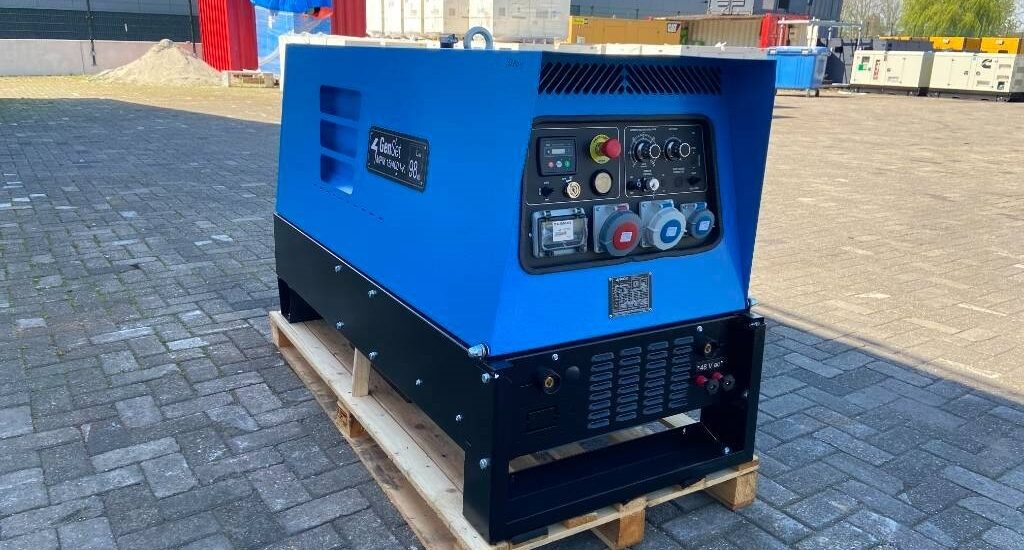
Can a 12.5kVA Generator Power a House?
Yes, a 12.5kVA generator for a house can provide enough backup power for many South African homes, but there is a catch: 12.5kVA does not mean you can switch on every appliance in the house at the same time.
The generator has to cope with the home’s actual electrical load, including appliances that draw much more power when they start. A geyser, electric stove, pool pump, borehole pump, air conditioner and refrigerator can quickly push demand higher than expected.
For a typical medium-sized home, a properly installed 12.5kVA diesel generator can comfortably supply essential circuits and a substantial portion of the household load. The right answer, however, comes from a load assessment, not simply the size of the house.
If you’re considering a 12.5kVA generator for a house, this guide explains what it can realistically run, where it may struggle and when you should move up to a larger generator.
What Does 12.5kVA Actually Mean?
Generator capacity is normally stated in kVA (kilovolt-amperes) than only kW.
A 12.5kVA generator will typically have an available real-power capacity somewhere around 10kW depending on the generators rated power factor and specification.
That distinction matters.
For example a generator advertised as 12.5kVA should not automatically be treated as a 12.5kW generator. The manufacturers nameplate is the reference, for rated kW, kVA, voltage, phase and operating conditions.
For household applications you also need to consider:
- Running power of each appliance
- Starting current of motors and compressors
- Whether the supply is single phase or three-phase
- Which appliances need to operate simultaneously
- Generator operating temperature and altitude
- Desired future expansion
- Whether an automatic transfer switch (ATS) will be installed
This is why simply adding appliance wattages from a quick internet table can produce a misleading answer. For a more detailed explanation of how to calculate running loads, starting loads and the right generator capacity, see our how to size a generator correctly.
What Can a 12.5kVA Generator Run in a South African Home?
The short answer is: quite a lot, if the loads are managed properly.
A 12.5kVA generator can typically support combinations of household essentials such as:
| Household Load | Typical Demand* | Suitable on 12.5kVA? |
|---|---|---|
| LED lighting | 100–500W | Yes |
| Wi-Fi/router | 10–50W | Yes |
| Television | 80–250W | Yes |
| Fridge/freezer | 100–400W running | Yes |
| Laptop/computer | 50–300W | Yes |
| Security system | 50–200W | Yes |
| Washing machine | 500–2,000W | Usually |
| Microwave | 1,000–1,800W | Usually |
| Dishwasher | 1,500–2,500W | Depends on other loads |
| Pool pump | 750–2,500W+ | Depends on motor size |
| Borehole pump | Varies considerably | Load assessment required |
| Geyser | 2,000–4,000W+ | Possible, but significant load |
| Electric stove/oven | 3,000–7,000W+ | Usually needs load management |
| Air conditioner | 1,000–3,000W+ | Depends on unit and starting demand |
*Actual consumption varies substantially by appliance, model and operating conditions. Motor-driven equipment can also have much higher starting demand than its normal running consumption.
The practical approach is to decide which appliances must operate during an outage and which ones can be switched off.
For example, a household might prioritise lights, refrigeration, internet, security, television, a washing machine and selected kitchen appliances while leaving the geyser and electric stove disconnected.
That can make a 12.5kVA set a very sensible residential solution.
A Realistic 12.5kVA Home Load Example
Consider a South African home with the following loads operating together:
| Appliance | Example Running Load |
| Refrigerator/freezer | 300W |
| Lighting | 400W |
| Television | 150W |
| Wi-Fi and electronics | 100W |
| Security system | 100W |
| Washing machine | 800W |
| Microwave | 1,200W |
| Pool pump | 1,500W |
| Geyser | 3,000W |
| Selected kitchen appliances | 1,000W |
| Example total | 8,550W |
An example load of roughly 8.6kW is within the practical output range of many 12.5kVA generator sets.
But there is an important qualification: the generator should not be selected purely because the arithmetic appears to fit.
Starting currents can change the situation.
A pump or compressor may briefly demand considerably more power when starting. If several motor-driven appliances start together, the generator can experience a substantial transient load.
That is one reason proper generator sizing matters.
What Appliances Should You Be Careful With?
Electric geysers
The geyser is often the appliance that surprises homeowners.
A typical household geyser can consume several kilowatts while its heating element is operating. If a 3kW geyser is running alongside a stove, pool pump and other household loads, the available generator capacity can disappear quickly.
For many homes, we recommend putting the geyser on a controlled circuit or allowing it to operate only when sufficient generator capacity is available.
Electric stoves and ovens
Electric cooking can be another major load.
A large oven plus multiple stove plates can consume several kilowatts. If the homeowner wants to run the entire kitchen while also operating a geyser, pool pump and air conditioners, a 12.5kVA set may no longer be the appropriate choice.
A gas hob or alternative cooking arrangement can dramatically reduce the electrical load during an outage.
Pool and borehole pumps
Pumps deserve special attention because they are motor loads.
The running wattage is only part of the story. Starting the motor can require a significant surge of current.
A correctly sized generator should be able to start the motor without excessive voltage or frequency dip.
If your property has a large borehole pump, irrigation system or multiple pumps, get the motor nameplate details before buying the generator.
Air conditioners
One small inverter air conditioner may be manageable. Several conventional air conditioners starting simultaneously are a different matter.
If cooling is essential, staggered starting, load management or inverter-driven equipment can make a substantial difference.
Can a 12.5kVA Generator Run an Entire House?
It can, but not necessarily an unrestricted whole-house load.
This distinction is worth understanding.
If your house has a modest electrical demand and you are not running every high-consumption appliance simultaneously, a 12.5kVA generator for a house may provide excellent whole-home backup.
If the property has:
- Multiple air conditioners
- Large electric geysers
- An electric stove and oven
- Swimming pool equipment
- Borehole pumps
- Electric underfloor heating
- Large refrigeration systems
- Workshops or heavy machinery
then 12.5kVA may be too small. If your calculated household load is slightly above the practical capacity of a 12.5kVA set, a 14kVA diesel generator may provide the additional capacity needed without jumping to a much larger generator.
Before choosing a larger generator, use our generator sizing guide to calculate your household’s running load and starting requirements.
12.5kVA Generator vs Larger Generator for a House
| Generator Size | Typical Residential Application |
| 7–9kVA | Essential household circuits, smaller homes |
| 12.5kVA | Medium homes with managed loads |
| 14–16kVA | Larger homes and higher simultaneous demand |
| 25kVA | Large homes, farms or properties with substantial electrical loads |
| 35kVA+ | Large estates, commercial properties or heavy electrical loads |
These are general sizing categories, not fixed rules. Two houses of the same size can have completely different generator requirements.
A 200m² house with gas cooking and solar water heating may require less generator capacity than a smaller house with a large electric geyser, pool pump, borehole and several air conditioners. For homes with consistently higher simultaneous demand, a 16kVA generator for higher household loads can provide useful additional headroom where a 12.5kVA or 14kVA set would be operating too close to its limit.
That is why square metres are a poor way to size a generator.
Should You Choose a Diesel Generator for Home Use?
For regular backup power, diesel generators are often attractive because they are designed for sustained operation and are widely used across residential, agricultural, commercial and industrial applications. If you’re comparing options for your property, our range of diesel generators for residential backup power can help you compare suitable generator capacities for different household requirements.
A diesel generator can make particular sense where:
- Outages can last for several hours
- The generator will operate regularly
- Reliability is more important than portability
- The property has a substantial electrical load
- Long service life is a priority
However, a diesel generator is not automatically the best solution for every home.
For occasional short outages, a smaller alternative may be sufficient. The decision should consider purchase price, fuel consumption, expected running hours, maintenance, noise, available installation space and the value of the equipment being protected.
Single-Phase or Three-Phase: Which Does Your House Need?
This is another detail homeowners sometimes overlook.
A 12.5kVA generator may be available in different electrical configurations depending on the manufacturer and model.
Before ordering, confirm whether your property requires:
- Single-phase supply
- Three-phase supply
- A specific voltage
- A specific frequency
- Compatibility with the existing distribution board
A three-phase generator should not simply be assumed to be interchangeable with a single-phase household supply.
The electrical installation needs to be designed correctly so that loads are properly distributed and the generator is not unnecessarily unbalanced.
If you’re unsure which configuration is suitable for your property, read our guide to single-phase vs three-phase generators before choosing a generator.
Automatic Transfer Switch: Is It Worth Installing?
For a permanently installed home generator, an automatic transfer switch (ATS) is often worth considering.
When the utility supply fails, the ATS detects the interruption and transfers the selected electrical load to the generator once it has started and stabilised.
When utility power returns, the system transfers the load back and can shut down the generator after a suitable cool-down period, depending on the control system.
This is considerably more convenient than manually connecting a portable generator every time there is an outage.
The installation must, however, be designed by a suitably qualified electrical professional. A generator must never be connected to a household electrical system in a way that can back-feed the utility supply. South African electrical work must comply with the applicable South African electrical installation regulations and be carried out by an appropriately qualified person.
South African electrical installation work is governed by applicable regulations and standards, and the Department of Employment and Labour has specifically reminded homeowners and contractors about the need for compliant electrical installations and competent registered electrical contractors.
How Much Fuel Does a 12.5kVA Generator Use?
The amount of fuel a 12.5kVA generator uses is not the same for every 12.5kVA generator.
It really depends on a lot of things like the engine and how well the alternator works and the load percentage and the temperature it is operating in and the altitude and how well the 12.5kVA generator is maintained and the design of the 12.5kVA generator.
If a 12.5kVA generator is not working hard it will use less fuel per hour than a 12.5kVA generator that is working really hard.
When you are looking at 12.5kVA generators you should ask the person selling them for the fuel consumption figures from the manufacturer at different load levels like:
- 25% load
- 50% load
- 75% load
- 100% load
This is much better, than just asking how much diesel the 12.5kVA generator uses.
If you think you will be using the 12.5kVA generator for a time you should think about how much fuel it uses when you are figuring out the total cost of owning the 12.5kVA generator.
For a closer look at expected fuel use at different load levels, see our 12.5kVA generator fuel consumption guide.
Installation and Safety Considerations
A residential generator needs more than a concrete slab and a fuel tank.
The installation should consider:
- Adequate ventilation
- Safe exhaust-gas discharge
- Correct cable sizing
- Earthing and protection
- Generator isolation
- Transfer switching
- Weather protection
- Noise
- Fuel storage
- Safe access for maintenance
- Clearance around the generator
- Protection against unauthorised access
Never operate a diesel generator inside a garage, enclosed room or other poorly ventilated space. Carbon monoxide and exhaust gases present a serious risk.
The electrical connection should also be carried out correctly. SABS develops and maintains South African National Standards, including standards relevant to electrical installations and equipment. For readers who want to review the applicable standards, the South African electrical standards provide the relevant reference point.
For a more detailed look at safe positioning, electrical connections, ventilation, earthing and other installation requirements, see our generator installation guide.
Expert Advice: Don’t Size the Generator From the House Alone
One of the most common mistakes we see customers make is choosing a generator based on the size of the house rather than the actual electrical load.
A four-bedroom home is not automatically a 12.5kVA application. Nor does a large house automatically require 25kVA.
We recommend starting with the appliances that genuinely need to operate during an outage. Establish their running loads, identify motor-starting loads and then consider which appliances can be controlled or excluded.
For a home considering a 12.5kVA generator for a house, this usually produces a much more sensible result than simply buying the next larger generator “to be safe”.
Oversizing is not free. A larger generator normally costs more to purchase, install and maintain, and may operate inefficiently if it spends most of its life carrying a very small load.
At the same time, undersizing can cause nuisance trips, voltage dips, difficult motor starting and excessive stress on the generator.
The objective is not to buy the biggest generator. It is to buy the right generator.
Common Generator-Sizing Mistakes Homeowners Make
1. Adding only the running wattages
Starting current from pumps, compressors and motors can change the calculation.
2. Assuming every 12.5kVA generator has identical specifications
Different engines, alternators and control systems can have different performance characteristics.
3. Ignoring the geyser
A geyser can consume a large part of the available capacity.
4. Forgetting future loads
If you plan to add an air conditioner, pool, borehole or electric vehicle charger, mention it before selecting the generator.
5. Buying based only on price
The cheapest generator may not offer the best long-term value. Consider engine quality, alternator, controller, service support, spare parts and warranty.
6. Connecting the generator without proper changeover equipment
Never improvise a connection to the home’s electrical system.
7. Ignoring maintenance
A generator that is not serviced properly may fail precisely when you need it.
For practical advice on service intervals, oil and filter changes, battery checks and routine inspections, see our diesel generator maintenance guide.
What About Businesses, Farms and Small Commercial Properties?
Although this article focuses on homes, the same sizing principles apply to small businesses, farms and other properties.
A 12.5kVA generator can be suitable for a small office, security installation, retail operation, guesthouse or agricultural application where the connected load is controlled.
But commercial users need to consider equipment such as:
- Computers and networking equipment
- Refrigeration
- Pumps
- Security systems
- Office air conditioning
- Point-of-sale systems
- Workshop equipment
- Agricultural motors
A farm, for example, might have a modest house but a substantial borehole or irrigation pump. The pump could determine the generator size more than the household appliances do.
Should You Buy a 12.5kVA Generator?
A 12.5kVA generator for a house is a strong option when your calculated backup load sits comfortably within its rated capacity and you have sensible control over high-demand appliances.
It is particularly suitable for homeowners who want more than basic emergency lighting and refrigeration but do not need to power every heavy electrical appliance simultaneously.
If your home has substantial motor loads, multiple air conditioners, electric cooking, large pumps or several geysers, have the load assessed before ordering. You may find that a 14kVA, 16kVA or 25kVA generator is the better long-term solution.
For current electricity-supply information, homeowners can check the official Eskom electricity supply and load-shedding information when planning their backup-power requirements. Municipal customers should also check their local municipality’s schedule where applicable.
Frequently Asked Questions
Can a 12.5kVA generator power a normal house?
Yes. A 12.5kVA generator can power medium sized homes. This is because the 12.5kVA generator can supply power.. You have to make sure that you do not connect too many things to the 12.5kVA generator at the same time.. You have to be careful with big appliances that use a lot of power.
Can a 12.5kVA generator run a geyser?
It can run a geyser.. This depends on how much power the geyser uses.. It also depends on what else is using power at the same time. A normal electric geyser uses a lot of power. So you have to make sure you include the geyser in your calculations.
Can a 12.5kVA generator run an electric stove?
It might be able to run a stove.. It depends on the stove and what else is on. A big electric stove with an oven uses a lot of power. So you might have to be careful about what else’s using power at the same time.
Can a 12.5kVA generator run a pool pump?
Usually it can run a pool pump.. You have to check the pump first. The pump might use a lot of power when it starts. This is more than it uses when it is running normally.
Is 12.5kVA enough for a four-bedroom house?
The number of bedrooms in a house does not tell you what size 12.5kVA generator you need. A four bedroom house with electrical loads might be okay with a 12.5kVA generator.. A four bedroom house with big air conditioners and electric heating might need a bigger 12.5kVA generator.
Is a 12.5kVA generator better than a 9kVA generator?
Not automatically. If your calculated load fits comfortably within 9kVA, a 9kVA diesel generator may be the more economical choice. If your demand is approaching the practical limit of 9kVA, 12.5kVA can provide useful additional headroom.
Should I buy a 12.5kVA or 14kVA generator?
Make the choice based on the measured or calculated load starting requirements and possible future expansion. If your need is close to 12.5kVA going up can give you headroom instead of running constantly near the generators maximum limit.
Can a 12.5kVA generator power a borehole pump?
It might be able to. The motor’s starting needs are very important. Get the details from the pump’s nameplate. Ask the generator seller to check if it works before you buy.
Does a 12.5kVA generator use a lot of diesel?
Fuel use changes depending on the generator model. How much power it is providing. A generator that is not working hard will usually use fuel each hour than one that is almost full. Always ask for the fuel consumption numbers from the maker at load levels.
Do I need an ATS for a home generator?
An ATS is not always needed,. It is a very helpful choice for generators that are installed permanently as backup. It can switch selected loads automatically when the electricity goes out.
Can I connect a generator directly to a wall socket?
No. Never use an unsafe way to connect that could send power back into the electrical system or the utility network. A proper switch or transfer system is needed.
How often should a home diesel generator be serviced?
Follow the schedule given by the generator maker. The time, between services depends on the engine. How it is used. Check oil, filters, coolant, batteries, belts and other parts as the maker says.
Conclusion
So, can a 12.5kVA generator power a house in South Africa?
For many homes, yes.
A properly specified 12.5kVA diesel generator can run essential household systems and a considerable selection of normal appliances. The deciding factor is not the number of bedrooms or the size of the property. It is the actual electrical load, starting demand and how that load is managed.
If you are comparing a 12.5kVA generator for a house with a smaller or larger set, start with your real appliance requirements. Pay particular attention to geysers, electric stoves, pumps, air conditioners and other motor loads.
For a permanent installation, also consider an ATS, correct changeover equipment, ventilation, exhaust routing, earthing and professional electrical installation.
If you are unsure whether 12.5kVA is sufficient for your property, Power Stay Solutions can help you work through the load requirements and identify a generator size that makes technical and financial sense. You can view our diesel generator range and compare the appropriate 7kVA, 9kVA, 14kVA, 16kVA, 25kVA and 35kVA generator options rather than guessing.
If you already know your approximate load requirements, you can request a generator quotation from Power Stay Solutions and we can help you select a suitable generator for your application.