
Prime vs Standby Generator Ratings Explained
Prime vs standby generator ratings: they’re the two numbers on almost every generator specification, and mixing them up is the most common reason businesses end up with the wrong size. The standby rating is the maximum a generator can deliver during an outage. The prime rating is what it can deliver for long hours, day after day. The standby figure is usually about 10% higher, which is why it’s the number in the name.
Prime vs standby generator ratings in plain terms
| Rating | What it means | Typical use |
|---|---|---|
| Standby | The most the generator can supply during a power failure, for a limited number of hours a year, at a varying load | Backup for outages at homes, offices and shops |
| Prime | What it can supply for unlimited hours a year at a varying load, with a short overload margin | Long daily outages, remote sites, farms and mines |
| Continuous | A constant, unchanging full load for unlimited hours | Generators that are the only power source, running flat out |
These categories come from the international standard for diesel generator sets, ISO 8528, which manufacturers use to rate their machines (see diesel generator for background).
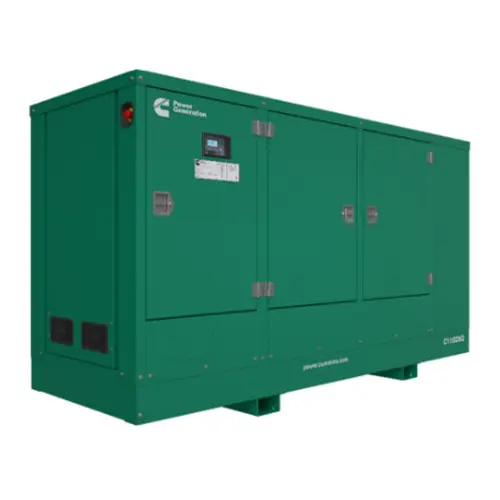
Real examples from our range
| Generator | Prime (continuous running) | Standby (outages) |
|---|---|---|
| 55kVA Cummins | 50kVA / 40kW | 55kVA / 44kW |
| 60kVA Hyundai | 60kVA / 48kW | 65kVA / 52kW |
| 170kVA Cummins | 155kVA / 124kW | 170kVA / 136kW |
| 275kVA Cummins | 250kVA / 200kW | 275kVA / 220kW |
| 400kVA Cat | 350kVA / 280kW | 400kVA / 320kW |
| 500kVA Cat | 450kVA / 360kW | 500kVA / 400kW |
Some generators, like our 50kVA Cat and 150kVA Cat, are rated for standby duty only. That’s fine for outages, but not the right choice if the generator will run for long hours every day.
Which rating should you size against?
- Outages of a few hours, a few times a month: size against the standby rating.
- Long daily outages, or several hours a day: size against the prime rating.
- Off-grid, or the generator is your main power: size against prime, or continuous if the load never changes, and leave headroom.
It also affects warranty. Cummins, for example, warrants many sets for two years or 500 hours on standby duty, but one year with unlimited hours on prime duty, because prime work is much harder on the engine.
Why it matters when comparing quotes
Two “100kVA” generators can be very different machines if one is quoted on standby and the other on prime. Always compare like with like. Our 400kVA vs 450kVA vs 500kVA and 110kVA vs 125kVA vs 150kVA comparisons show how much this changes the answer. For kW vs kVA, see kW vs kVA.
Frequently asked questions
What is the difference between prime and standby power?
Standby is the maximum for outages, for limited hours a year. Prime is what the generator can deliver for unlimited hours at a varying load. Standby is usually about 10% higher.
Can I run a standby generator every day?
For short outages, yes. For long daily running, choose a prime-rated generator and size against its prime figure.
Which number is in the generator’s name?
Usually the standby rating, because it’s the bigger number.
Is a prime-rated generator better?
It’s built for harder work. If your generator only covers occasional outages, a standby-rated set is perfectly suitable and often costs less.